
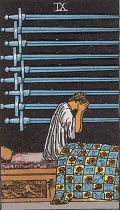
Hardships that come from outside are usually less damaging than the internal regrets and mental anguish that we feel inside. At least that is what this card is telling us. Problems from our surroundings can often be avoided just by moving out of their reach, and sometimes all we need to do to improve our situation is to keep calm and keep a sharp mind. Internal problems, on the other hand, go with us wherever we go and usually drain our energy to the point where we can't even think about escaping the vicious circle of constant unrest. We can see this described on this card. Even in their own bed this person just can't get peace of mind. Constant regret about things that can't be changed, things that we've done or haven't done, worries about the future and depression about the past: why not just live in the present, get some sleep and be ready for the next day? But this is not how the air element operates; when disturbed, it has the dangerous trait of being extremely hard to calm. The mind's constant monologue can torture a person with a windy and troubled mind. Just see how the swords are arranged, one worry after another in an endless chain. In Eastern philosophy the mind has been described as a monkey that can never stop. It has its value in everyday life, of course, but the trick is that it should be a slave, not a master, to the man.
On the card
A figure sits upright in bed in the middle of the night, face buried in both hands. The room is completely dark: the background is solid black, broken only by nine swords that hang horizontally one above the other across the wall. The swords do not touch the sleeper. They are not wounds but thoughts, stacked up in the darkness, filling the space that should be quiet.
The bed is covered with a quilt decorated with red roses and with astrological and planetary symbols, set in a chequered pattern. The roses and the order of the heavens are still there, close at hand, but the person cannot see them through their distress. On the side of the bed is a carved panel showing one figure attacking another, a small image of conflict hidden in the very place meant for rest.
The card is often called the card of nightmares. What it shows is not an outside danger but the sleepless state in which fears, guilt and worries take over the mind. The black wall suggests that in the night everything looks worse than it is, and that morning, not more thinking, is often the answer.
Upright
Despair, regret, mental anguish, concern, suffering, shame, suspicion, infidelity, hopelessness, anxiety.
Reversed
Despair, regret, mental anguish, concern, suffering, shame, suspicion, infidelity, hopelessness, anxiety.