
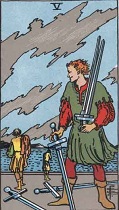
This card usually represents defeat. The reason is obvious. Two defeated figures are moving away from what seems to have been a battlefield of some sort; their swords are abandoned on the field while a victorious figure looks at them with a mix of scorn and amusement. The real question is: who represents you? Are you victorious or defeated? Unfortunately, this card usually tells us that it is you who are defeated. In that case the lesson is not to be absorbed in self-pity and disappointment, but to carry on, learn from defeat, come back and try again. Sometimes this card speaks about giving up; we are not sure whether these two figures are just walking away after throwing down their swords or whether they were actually defeated in battle. Either way, a new assessment is required for a new attempt. If you feel that you are winning, pay attention: maybe it is not all over. Beware of arrogance. The winner holds two swords in his right hand, a connection with the Two of Swords: there will always be a balance between losing and winning, and there is no place for pride there.
On the card
In the foreground a young man with red hair and a smug expression gathers up swords after a conflict. He holds three swords, two resting against his shoulder and one pointing down to the ground, and two more lie at his feet. He looks over his shoulder at the two figures walking away from him with something like a sneer.
The two other figures are smaller and further back. One walks away with his back to us, and the other appears to have his face in his hand, as if in grief or shame. They have left their swords behind. Beyond them is a stretch of water and a distant shoreline.
The sky is unsettled, with jagged, broken clouds streaming across it, which gives the whole scene a sense of tension and aftermath. The fight is over, but the air has not cleared.
The card shows a victory that feels empty. One person has won, but the cost has been the loss of goodwill and the humiliation of others. It raises the question of what has really been gained when winning becomes more important than the relationships that were damaged along the way.
Upright
Defeat, renouncement.
Reversed
Spite, treachery, loss, defeat, Pyrrhic victory, degradation, humiliation, no-win situation, winning a battle while losing the war, plots behind one's back, weakness, selfish gain, indecision.