
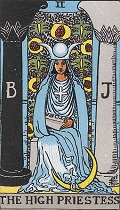
After the unmanifested reality and unity consciousness of The Fool, and the manifested world and focused action of The Magician, we come to the duality of The High Priestess. This card is the realm of opposites. As soon as we see the card, we notice the black and white pillars of the temple, labelled "B" and "J". A gentle reminder of the pillars of the Temple of Solomon, they are the first detail that implies duality and opposition, but also hidden wisdom and forbidden knowledge. The card's number is two, further supporting the duality and the passive, feminine energies of the card. The woman on the card sits still, without action, seemingly pondering decisions she is about to make. The card shows silence, passivity, the power of non-action. Only when secluded from the world can we allow our subconscious to speak to us, listen to our inner voice and recognize our spiritual power. The High Priestess stands for inner wisdom at its deepest, a wisdom that sleeps beneath the myriad intrusions of the everyday world. Her energies complement the energies of The Magician. She is passive, he is active; he is all about skill and ability, while she is still, in a state of insight. Sitting between the duality of the two pillars, she is the symbol of duality and at the same time she helps us transcend that same duality. She is our connection between everyday consciousness and the subconscious mind, where we are in an intimate bond with the rest of the universe. This bridge is no easy pass: she is the connection, but also the guardian of the unknown. There is a challenge to go deeper, beyond the obvious and beyond the usual daily affairs.
On the card
A woman is sitting between two pillars. She represents the subconscious mind, the Shekinah, the female presence of the divine. The pillars are black and white, obviously pointing to their different origins. She sits between them, impartial to both. She balances opposite forces, serving as a bridge between the two. The curtain behind her connects the pair. The letters on the pillars are B and J. B is symbolic of the number 2, being the second letter of the alphabet. J is the 10th letter of the alphabet, and in numerology this reduces to 1. So on the pillars we have the numbers 1 and 2, symbolic of male and female, the two opposites. The card itself is numbered 2, indicating its female nature. Also, "B" for Boaz and "J" for Jachin were the two copper, brass or bronze pillars that stood in the porch of Solomon's Temple, the first Temple in Jerusalem. The pillars bore decorations of brass lilies, and lilies are a very frequent motif in the Major Arcana. The High Priestess holds a scroll of knowledge, but only part of it is shown: at least part of the knowledge is hidden. Only four letters are visible, TORA, suggesting the Torah, or perhaps an anagram of TAROT with one letter still hidden. On the other hand, if you read the letters of the word TORA in a circle, you get the word TAROT. You can also get the word ROTA, which is Latin for wheel. The sentence "Tarot Rota Tora" is said to mean that the Tarot reveals the wheel of truth. She sits on a cubical block that indicates the strict order in which the subconscious mind carries out the orders formulated by the conscious mind. It is no accident that The High Priestess is painted sitting. This card is about knowledge before action. Her knowledge has an inner quality; the outer quality of knowledge, religion, is shown in The Hierophant card. Her other counterpart, The Magician, is standing and performing action, while the second female archetype of the tarot, The Empress, is also sitting, emanating abundance by her presence rather than by action. Behind the throne is a curtain decorated with pomegranates, part of which clearly resembles the Tree of Life. The pomegranates recall Persephone, who was taken down into the land of the dead, ate its fruit and became the only goddess allowed to travel to and from that strange land. Similarly, The High Priestess is our guide to all that is mysterious and mystical. Behind the curtain we see a body of water, probably a motif depicting the vastness and depth of the subconscious mind. The water is not contained behind the curtain: we can see her dress flowing down like water beyond the edge of the card, telling us that the subconscious mind extends its reach to the other cards of the Major Arcana. We also see a crescent Moon at her feet, another clue about the nature of this card. The Moon traditionally represents intuitive, female energies and the deep realms of the subconscious. The Moon motif is also visible on her crown, which is very similar to the crown of Hathor. It is as if the artist wanted to show the phases of the Moon on the crown, indicating not only the passage of time but also oscillation and change, the cyclic repetition of events. This goes well with the strong presence of the water element in the card, which also brings a feeling of change and uncertainty. Her watery blue robe has a solar cross on her chest, an interesting detail symbolizing that although the Moon has a deep connection with our inner world, in the end it only reflects the light given by the Sun.
Upright
In readings, this card represents hidden wisdom. Pay attention to your subconscious qualities and trust your intuition. Beneath the surface a lot is happening. Now it is important to listen to your inner voice. Remember your inner strength and potential. Be patient. Sometimes it can mean that a spiritual woman will enter your life, perhaps a reclusive relative who knows many family secrets.
Reversed
Some aspects of this card are superficiality and outmoded ways of behaving. This card often indicates that the situation is clear and there are no secrets to ponder. Now it is time for action.