
Ogham
The Celtic tree oracle
For the Celtic tree alphabet, few casts, and grove lore.

The twenty trees of the Celtic alphabet, drawn fresh for every question.
Oracle / Ogham
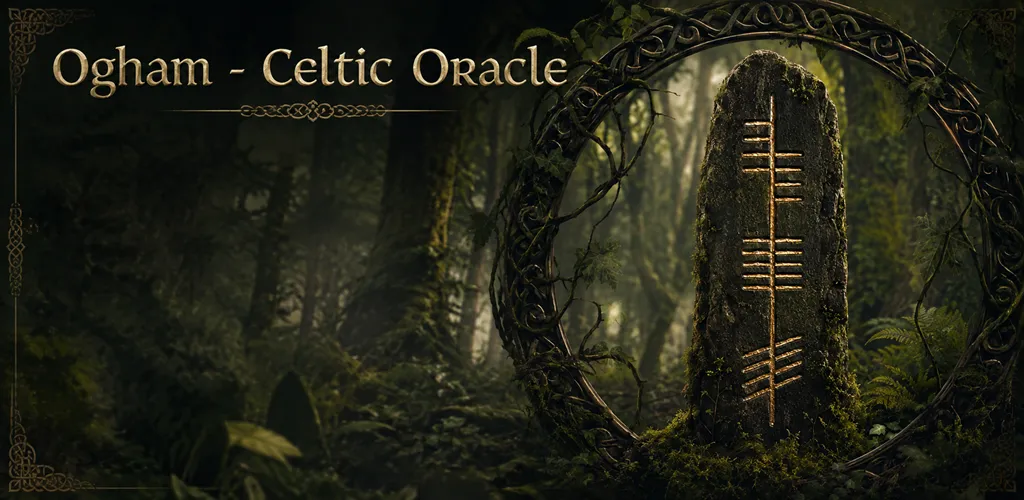
Ogham is the early Irish alphabet cut as notches along the edge of a standing stone, read from the bottom up. Its twenty letters, the feda, fall into four families of five called aicme, and five more signs, the forfeda, were added later. Medieval scholars gave many of the letters the names of trees, which is where the tree lore of the ogham comes from.
There is no surviving rule for reading ogham as an oracle; the spreads here are modern. Draw from the twenty classical feda, or add the forfeda for the full set of twenty-five.
Ogham is an early medieval Irish alphabet, known from some four hundred inscribed stones of roughly the fourth to sixth centuries. Each letter, a fid (plural feda), is a group of one to five strokes cut along a central line. The twenty primary feda fall into four families of five, the aicmí, and five later letters, the forfeda, were added by medieval scholars.
Divining with ogham has a real basis in the sources. J. A. MacCulloch, summarising the Irish texts in The Religion of the Ancient Celts (1911), writes that “Ogams were also engraved on rods of yews, and from these Druids divined hidden things.” In the tale of the Wooing of Étaín, the druid Dalan uses such rods to find where the queen has been hidden. MacCulloch suggests the method “may have been that of drawing one of the rods by lot and then divining from the marks upon it.”
What no medieval text gives is a table of meanings. The meanings used in readings today are modern, drawn from the letter names, the trees associated with them, and Irish and Scottish lore. The complete tree calendar many people know was largely shaped by Robert Graves in 1948. It is a beautiful system to think with, but it is a reconstruction.
A reading follows the shape the sources describe: the feda are mixed, and one or more are drawn by lot.
When you read a fid, look at three things. First, its name and the tree or word behind it: birch for beginnings, oak for strength and endurance, yew for what outlasts. Second, its place in its aicme and its neighbours there. Third, how its meaning presses against the actual shape of your question. A fid rarely answers yes or no; it offers a quality to bring into the situation, or one to watch for.
There is no ancient rulebook for spreads, so consistency matters more than any particular choice. Pick a way of asking and a layout, keep them, and let the meanings speak against your question. Over time the feda become less like keywords and more like familiar trees.
The app keeps a history of your readings, has a sign for every day and a home-screen widget, and goes further into the tradition.
The Celtic tree oracle
For the Celtic tree alphabet, few casts, and grove lore.