Ogham Divination: Yew Rods, Irish Seers and the Modern Reading
What the Irish sources say about druids divining with ogham on yew rods, the other ways early Irish seers sought hidden knowledge, and how a modern ogham reading is laid out.
 By Arcadia ·
Ogham is an early medieval Irish alphabet, known mainly from stone inscriptions dating roughly to the fourth to sixth centuries. It is one of the most distinctive writing systems ever devised: not a set of shapes like the Latin or Greek letters, but a set of strokes counted along a line.
Today ogham is known to many people through the tree alphabet and through divination. Both have real roots, but both have also gathered a great deal of modern material, and it helps to know which is which. This article explains the script itself, the order of its letters, what the inscriptions actually say, and how the familiar tree associations came about. A companion article covers ogham divination.
Each ogham letter is called a fid (plural feda), a word that also means “wood” or “tree”. A fid is a set of strokes cut across or beside a central line called the druim, the “ridge” or “back”. On a standing stone the druim is usually the edge of the stone itself, so that the strokes are cut on the two faces meeting at that edge. The inscriptions run up the edge and are read from the bottom, sometimes continuing over the top and down the other side.
The letters are distinguished by two things: which way the strokes lie, and how many there are. One group of letters is cut on one side of the line, a second group on the other side, a third across the line at a slant, and the vowels as short strokes or notches on or across the line. Within each group the letters have one to five strokes. A reader who knows the groups can therefore decode any letter by asking only two questions: which side, and how many?
That design suits cutting with a knife on wood or a chisel on stone, where curves are hard and straight strokes are easy. It is a script made for an edge.
The twenty original letters are arranged in four families of five, called aicmí (singular aicme, “family” or “group”). Each aicme is named after its first letter.
Learning this order is the first step for anyone who wants to read ogham, whether on a stone or in a reading. The aicmí are the skeleton on which everything else hangs.
The order is also strange in a revealing way. It does not follow the Latin alphabet, and it groups letters in fives rather than by sound type alone. Scholars have debated its origin for a long time. Many think its inventors knew Latin and the way Roman grammarians classified letters, and designed a new system for the Irish language with that knowledge in mind. Medieval Irish tradition, for its part, credited the invention to Ogma, a figure of learning and eloquence among the old gods.
To the twenty primary letters, the manuscript tradition adds five more, called forfeda, “additional letters”. They usually appear with names such as Ébad, Óir, Uilleann, Ifín (or Pín) and Emancholl, and with values for diphthongs or for sounds the original twenty did not cover. They are rare on the early stones and belong mostly to the later, scholarly use of the script. Their sound values and names vary between manuscripts, and scholars still argue about them. Anyone using the forfeda in a reading should know that they stand on less firm ground than the twenty.
Some four hundred ogham stones survive, mostly in Ireland and western Britain. The largest numbers are in the south of Ireland, in the counties of Kerry, Cork and Waterford, but they are also found in Wales, Scotland, the Isle of Man and south-west England.
The inscriptions are short, and they are almost always names. The typical stone commemorates a person and gives his descent: a name, followed by a word meaning “son of” and the father’s name, sometimes with the name of a wider kin group or ancestor. They seem to have served as memorials and perhaps as markers of land or inheritance. In Wales a number of stones carry the same name twice, once in ogham and once in Latin letters, and these bilingual stones were important in working out the letter values with certainty.
The language of the oldest inscriptions is an early form of Irish, older than anything written in manuscripts. This makes the stones precious to historians of the language, even though they say little about religion or belief. There are no ogham spells on the stones, no prophecies and no tree lore: only people and their families.
After the inscription period, ogham lived on in the manuscripts. Medieval Irish scholars wrote treatises on it, including the grammar known as Auraicept na nÉces and the Ogham Tract preserved in the fourteenth-century Book of Ballymote. These texts list the letters and their names, describe dozens of variant “oghams” (some of them more like learned games than practical scripts), and give each fid a short poetic gloss known as a word-ogham. The word-oghams, attributed in the tradition to figures such as Morann, Mac ind Óc and Cú Chulainn, are the only medieval meanings the letters have.
Many people meet ogham first as a “tree alphabet”, each letter paired with a tree such as birch, oak or yew. The pairing has a real medieval basis. Several of the letter names are ordinary tree words: Beith is birch, Fearn is alder, Sail is willow, Dair is oak, Coll is hazel, and Iodhadh is generally taken as yew. The medieval scholars went further and assigned a tree or plant to every letter, sometimes by stretching a name that originally meant something else. Gort, for example, appears to have meant “field” before it was read as ivy.
So the idea that ogham letters are trees is old in outline. What is not old is the neat, complete system most people know today. The tree calendar of thirteen months, each ruled by one fid, was largely shaped by the poet Robert Graves in The White Goddess (1948). It is a beautiful system to think with, but it is a reconstruction, not a survival from the druids.
Use it, and know what it is. The trees themselves have plenty of genuine lore in Irish and Scottish tradition: the hazel of wisdom, the rowan against enchantment, the hawthorn left standing for the fairies. That lore is worth reading in its own right, apart from any calendar.
Because ogham has attracted so much modern writing, it is useful to sort claims about it into three kinds.
Attested. It stands in a medieval text, an early modern text or a classical writer, as a modern scholar reports it. The ogham letters, their names and aicmí, the druids divining from rods of yew, the four quarter days of the Celtic year, Pliny’s account of the druids and the oak: all of these are attested.
Folk. It was written down from living people by collectors in the nineteenth century, such as Alexander Carmichael in the Hebrides and Lady Wilde in the west of Ireland. Blessings, charms, the hawthorn that must not be cut, the woods that must not be burned. This is real practice, recorded, but not ancient in the form we have it.
Modern. The twentieth century or later. Every table of divinatory meanings for the feda. The thirteen-month tree calendar of Robert Graves. The tree oracle as a system of cards or staves. The solstices and equinoxes placed on a Celtic wheel of the year.
Where the sources say nothing, the honest course is to say nothing. Not every one of the twenty trees has a body of genuine lore behind it, and a gap in the record is better left visible than filled with invention.
To put it plainly: ogham itself is old. It is an early medieval Irish script, cut on some four hundred surviving stones. The twenty primary feda, their four aicmí, their letter values and their traditional names are attested. So are the five forfeda, though their values and names are less certain.
Divining with ogham is old too, at least in outline: the Irish texts say that the druids cut ogham on rods of yew and divined from them. What is not old is any table of what each letter means in a reading. Divinatory meanings, spreads, reversed readings and the tree calendar are modern.
None of this makes the practice worthless. A symbolic system does its work by giving your thinking a shape to push against, and this one is beautiful. But it is honest to know which half you are holding.
What the Irish sources say about druids divining with ogham on yew rods, the other ways early Irish seers sought hidden knowledge, and how a modern ogham reading is laid out.
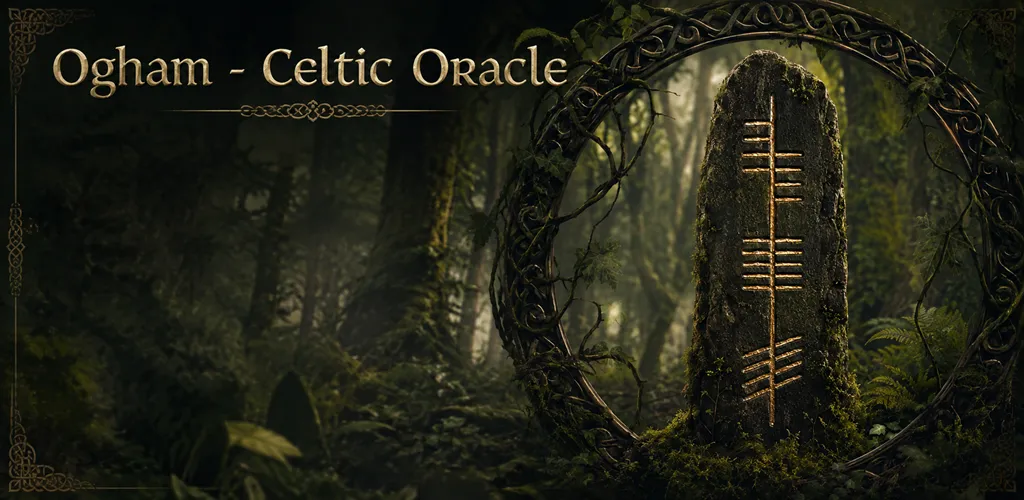

The Celtic tree oracle
For the Celtic tree alphabet, few casts, and grove lore.