
IChing Revealer
Hexagram readings and change
For change, timing, and classical hexagram guidance.

Six lines, three coins each. One of sixty-four hexagrams, and where it is turning.
Oracle / I Ching
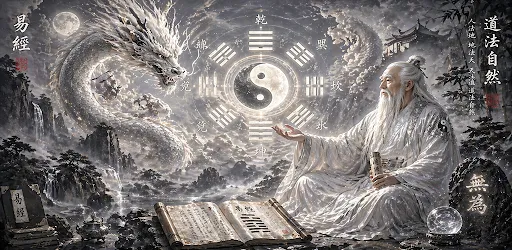
The I Ching, the Book of Changes, is one of the oldest Chinese classics. Its core, the Zhouyi, dates to the Western Zhou period, around three thousand years ago. It is built from sixty-four figures of six lines each, every line either solid or broken, and every figure a pair of the eight trigrams: heaven, lake, fire, thunder, wind, water, mountain and earth.
The coin method throws three coins for each line, from the bottom up. Most lines are settled, but some are moving, about to turn into their opposite. Those moving lines carry their own advice, and together they show the hexagram the situation is turning into. The texts here are written for this site and the Arcadia apps; they are not a translation.
The I Ching, or Book of Changes, is one of the oldest Chinese classics, both a book of wisdom and an oracle. It does not hand out a fixed fate. It describes the quality of a moment: what forces are moving, which are rising and which are fading, and what attitude fits the time.
The book responds best to a clear question about a real situation or decision. “What should I understand about this conflict?” or “What attitude should I take toward this delay?” will give a far more useful reading than “Will everything be all right?” Ask for orientation rather than prediction, and ask once: the book itself warns that restless, repeated asking receives no instruction.
A consultation produces a hexagram: six lines, built from the bottom upward, each either solid (yang) or broken (yin). The traditional coin method casts three coins six times, with heads counting 3 and tails 2. A total of 7 gives a stable yang line and 8 a stable yin line. A total of 9 gives an old yang line and 6 an old yin line: these are changing lines, forces that have reached their extreme and are about to turn into their opposite.
The six lines also form two trigrams, a lower and an upper, each one of eight images: Heaven, Earth, Thunder, Water, Mountain, Wind, Fire and Lake.
Start with the Judgment, the short statement for the whole hexagram. It names the condition of the moment and often gives advice about conduct or timing. Then read the Image, which draws a lesson from the two trigrams and says how a wise person responds. The Judgment tells you what kind of moment this is; the Image tells you how to inhabit it.
If there are changing lines, read their line statements next. They show where the situation is most alive, and they are often where the advice becomes concrete.
Changing lines also produce a second hexagram: turn each changing line into its opposite and leave the rest as they are. This second figure does not replace the first. It shows the direction in which the situation is moving.
A difficult hexagram is not doom. It may mean the timing is wrong, the approach is wrong, or patience is part of the work. A favourable one is not permission to be careless, since good fortune in the book is always tied to right conduct. Write the reading down and return to it later, when its pattern has had time to unfold.
The app keeps a history of your readings, has a sign for every day and a home-screen widget, and goes further into the tradition.
Hexagram readings and change
For change, timing, and classical hexagram guidance.