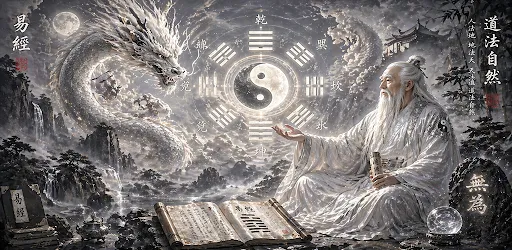
The I Ching, or Book of Changes, is one of the oldest classics of China. It is both a wisdom text and an oracle, and people have used it for many centuries to reflect on timing, change, character and decision. In the West it is often met first as a method of divination, but in China it was also a central book of philosophy, read and commented on by scholars who never cast a coin.
This article explains what the book is and how it is built: the two kinds of line, the eight trigrams, the sixty-four hexagrams, and the order in which they are arranged. A companion article covers how to consult it.
A book of pattern, not fixed fate
At its core, the I Ching does not hand out fixed fate. It shows pattern. Its questions are: what kind of moment is this, what forces are moving, and what attitude fits the time?
A reading produces a hexagram, a figure of six lines. Some lines are steady and some are changing. Together they describe a living situation rather than a simple yes or no. Each hexagram has a name and a short text, and each of its six lines has its own short statement.
This is why the I Ching has stayed useful for so long. It does not try to replace judgment. It sharpens judgment by helping you see movement more clearly.
Where the book comes from
The core of the book is known as the Zhou Yi, the “Changes of Zhou”, after the Zhou dynasty in whose early centuries it took shape, roughly three thousand years ago. Tradition gives it a long line of sages. The legendary ruler Fu Xi is said to have discovered the eight trigrams by observing the patterns of heaven and earth. King Wen, father of the founder of the Zhou dynasty, is said to have arranged the sixty-four hexagrams and written their judgments while imprisoned, and his son the Duke of Zhou to have added the line statements. These attributions are traditional rather than historical, but they show how the Chinese understood the book: as the accumulated insight of several generations.
To this core was added a set of commentaries known as the Ten Wings, traditionally attributed to Confucius, though modern scholars date them later. The Wings explain the trigrams, interpret the images, and give the book its philosophical depth. With them the I Ching became one of the Five Classics of the Confucian canon. It reached Western readers through translations such as James Legge’s of 1882 and Richard Wilhelm’s German version of 1924, which was later put into English.
Yin and yang: two line types, one field of change
Every hexagram is built from two kinds of lines: broken yin lines and solid yang lines. Yin and yang are not enemies. They are complementary forces that shape one another, and each contains the seed of the other.
Yang points to activity, firmness, visibility, initiative and outward movement. Yin points to receptivity, yielding, support, depth and inward movement. Neither is better. Meaning comes from balance, timing and relation.
The I Ching works with these two because situations are never static. A strong phase may need restraint. A yielding phase may hide real strength. When a force reaches its extreme, it begins to turn into its opposite, which is why the book speaks so often of excess, reversal and return. A reading helps you see which quality is rising, which is fading, and what response is wise.
When you read a hexagram, do not reduce it to simple opposites. Look for rhythm. The wisdom is in how yin and yang meet.
The eight trigrams
The sixty-four hexagrams are built from eight trigrams. A trigram is a figure of three lines, and since each line can be yin or yang there are exactly eight of them. Each carries images, natural forces, family roles and patterns of action.
- Qian, three yang lines: Heaven. Creative, strong, the father.
- Kun, three yin lines: Earth. Receptive, yielding, the mother.
- Zhen, one yang line beneath two yin: Thunder. Arousing, the eldest son.
- Kan, one yang line between two yin: Water. Abysmal, dangerous, the middle son.
- Gen, one yang line above two yin: Mountain. Still, the youngest son.
- Xun, one yin line beneath two yang: Wind or Wood. Gentle, penetrating, the eldest daughter.
- Li, one yin line between two yang: Fire. Clinging, bright, the middle daughter.
- Dui, one yin line above two yang: Lake or Marsh. Joyous, the youngest daughter.
The family roles follow a simple logic. Heaven and Earth are the parents. In the “sons” a single yang line sits among yin lines, and its position (bottom, middle or top) gives the eldest, middle or youngest. The “daughters” work the same way with a single yin line among yang.
A hexagram combines a lower trigram and an upper trigram. This creates a situation: fire above water, thunder over lake, mountain above wind, and so on. The image helps you feel the structure of the moment instead of reading it as a dry code. Fire above water, for example, is the hexagram called Before Completion: the two elements are each moving away from the other, fire upward and water downward, and the work of bringing them into relation is not yet done.
Learning the trigrams gives you a stronger reading instinct. Even before you open the text, the shape itself starts to speak.
The sixty-four hexagrams
A hexagram has six lines stacked from bottom to top. Because each line can be yin or yang, there are sixty-four possible patterns (two multiplied by itself six times). Each one names a situation in life, not only an abstract concept.
Some hexagrams show beginnings, such as Difficulty at the Beginning or Youthful Folly. Some show conflict, nourishment, waiting, union, decline, breakthrough, return or completion. Together they form a map of recurring human conditions.
The hexagram is read as a structure, and the position of each line matters. Lines are counted from the bottom. The lower lines often show beginnings, foundations and what is still hidden; the upper lines often show outcome, excess, culmination, or what comes after the main event. The second line, in the middle of the lower trigram, and the fifth, in the middle of the upper, are central positions and are often favourable. The fifth is traditionally the place of the ruler, and the sixth, at the very top, can mean that a movement has gone past its proper limit.
Do not worry about memorising all sixty-four at once. Over time you begin to recognise families of meaning and the larger rhythm between them.
The King Wen sequence
The most common arrangement of the sixty-four hexagrams is called the King Wen sequence. It is the order used in most traditional editions and commentaries, and the one by which hexagrams are usually numbered.
It opens with the two pure figures: Qian, the Creative, all yang, and Kun, the Receptive, all yin. It closes, strikingly, with After Completion followed by Before Completion. The book does not end on finality. It ends on the threshold of a new cycle.
Within the sequence, the hexagrams come in pairs. In most pairs the second figure is the first turned upside down; where turning a figure over would leave it unchanged, its partner has every line reversed instead. Each situation is shown beside its mirror.
This sequence is not just catalogue storage. Many readers treat it as a meaningful flow, and one of the Ten Wings is devoted to explaining why each hexagram follows the last. One condition gives rise to another. Conflict leads to the gathering of an army. Abundance is followed by the Wanderer, as fullness gives way to decline. Return follows Splitting Apart.
You do not need to master the whole sequence at the start. But it helps to know that each hexagram sits in relationship to others. The book thinks in transitions, not isolated slogans.
Why the structure matters
All of this structure serves one purpose: to let a reader see a moment as part of a movement. Two kinds of line become eight images of nature; the images combine into sixty-four situations; the situations are ordered so that each leads to the next. When you consult the book, you are not drawing a random message. You are locating yourself within a pattern of change that the book has spent three thousand years describing.
This is one reason the I Ching rewards repeated use. It slowly teaches pattern through recurrence, and the reader who returns to it finds that the same figures, met in different circumstances, keep revealing new sides.