The Rune Poems: Old English, Norwegian and Icelandic Verses and Their Kennings
The three medieval rune poems are the closest we come to a voice from inside the runic tradition. What each one is, why they differ, and how to read their kennings.
 By Arcadia ·
No handbook of rune divination survives from the Viking age. What we have are hints: a Roman historian describing lots cast on a white cloth, poems about runes cut for victory or healing, sagas in which runes are carved and read. Modern rune reading is built on those hints and on a century of practice, and it is best approached as a way of thinking about a question rather than a way of predicting its outcome.
This article starts with the oldest evidence, the account of Tacitus, and is honest about what it proves. It then sets out the common layouts, the question of reversed runes, and the making of a set of your own.
In AD 98 the Roman historian Tacitus wrote a short book about the peoples beyond the Rhine, the Germania. In its tenth chapter he describes how they consulted the lots.
They cut a branch from a fruit-bearing tree into slips and mark each slip with a sign. They scatter the slips at random over a white cloth. If the question concerns the community, the priest of the tribe does this; if it is a private matter, the father of the household. He prays to the gods, looks up to the sky, and takes up three slips one at a time, reading them by the signs marked on them. If the lots forbid, the matter is not asked again that day; if they allow it, the answer must still be confirmed by other omens, such as the flight of birds or the neighing of sacred white horses.
It is a vivid scene, and it is often claimed as proof that the Germanic peoples divined with runes. It is not.
Tacitus says the slips were marked with signs, notae. He does not say what the signs were. His book is older than the earliest runic inscriptions we can date, which come from later in the second century, so the signs may have been something else entirely: family marks, symbols, pictures. The link between his lots and the runes is a guess, and an old one, but it is a guess.
A second Roman witness is older still. Julius Caesar, in his Gallic War, tells how one of his officers, held prisoner by the Germanic king Ariovistus, was saved by the lots: three times they were cast to decide whether he should be burned at once, and three times they said to wait.
What the two Romans do show is that casting lots was a serious act, done with prayer, repeated rarely, and read with care. That is a good spirit in which to cast.
A clear question gets a clearer answer than a vague one. “What do I need to understand about this job offer?” works better than “What will happen?” Questions that ask what to see, understand or attend to suit the runes better than questions that ask for a yes, a no or a date.
Tacitus’s rule is worth keeping too. If a casting gives an answer you do not like, do not cast again on the same question the same day. Sit with what fell.
Runes can be cast onto a cloth and read where they land, or drawn one at a time from a bag and laid in order. Most modern readers use set layouts, in which each position has a meaning.
One rune, one answer. This is the simplest reading and often the most useful. Many readers draw one rune in the morning as a theme to carry through the day.
Three runes, named for the Norns at the well of Urðr: Urðr for what was, Verðandi for what is becoming, Skuld for what shall be. Read the first as the ground of the situation, the second as what is in motion now, and the third as where it is heading, or, in keeping with Skuld’s name, what is owed.
Past, Present, Future, Hidden and Potential. The first three are read as in the Norns layout. The fourth rune shows what works under the surface; the fifth shows what the matter could still become.
A rune for each of the nine worlds of Norse cosmology, from Asgard, the highest aim, down to Helheim, what must be let go. The meanings of the positions are a modern interpretation built from the character of each world.
Three runes taken up one at a time, as Tacitus describes, and read together as a single answer rather than as three separate positions. This is the closest a modern reader can come to the one ancient account, though it borrows Tacitus’s method without knowing his signs.
Read each rune first on its own, then in relation to its position, then together with the others. Ask what the runes have in common and where they pull against each other. A reading in which Isa, the ice, sits in the present and Sowilo, the sun, sits in the future tells a story of its own: something frozen now, and the warmth that may melt it.
A rune can be read by its modern meaning, by the stanzas of the medieval rune poems, or both. The poems are older than any modern meaning, and often stranger. The runes do not decide anything for you. Read what falls, sit with it, and see what it shows you about your question.
In many modern readings a rune can fall reversed, upside down, and is then read with a darker or blocked meaning. Some readers call a reversed rune merkstave.
It is worth knowing that reversed reading is modern. No saga, poem or inscription describes reading a rune by which way up it fell. Tacitus’s lots were read by their signs, not their direction. The rune poems give each rune one stanza, not two. The practice took shape in the rune revival of the twentieth century, most likely by analogy with reversed cards in tarot, and the word merkstave belongs to that revival too.
Runes did appear reversed and mirrored in old inscriptions, but for other reasons: a carver writing right to left, a line running around the edge of a stone, simple variation of shape. On the stones, a rune upside down is usually just a rune.
Reversal is still a useful tool. A reversed rune asks you to look at the other side of its meaning: the gift that is withheld, the strength that turns against itself. Some runes cannot be reversed at all because their shape is the same either way up. In the Elder Futhark these are Gebo, Hagalaz, Isa, Jera, Eihwaz, Sowilo, Ingwaz and Dagaz, and in the Younger row Hagall, Íss, Ár and Sól; they are always read upright. Nauthiz looks much the same when turned, but many readers still give it a reversed meaning.
Use reversal if it helps you think, and leave it out if you would rather read the runes as the old poems did.
Many people who read runes want a set they can hold. Making one is simple, and the making is part of the practice.
Wood is the traditional choice. Tacitus describes slips cut from a branch of a fruit-bearing tree, and wood is what most everyday runes were carved on. A straight branch of fruitwood, birch or ash, cut into discs or small staves, gives you a set in an afternoon. Let the wood dry, sand the faces, and cut or burn one rune into each.
Stones work too. Smooth pebbles from a beach or river, painted or scratched, make a set that lasts. Clay, bone and antler have all been used.
Make as many runes as the row you use: twenty-four for the Elder Futhark, sixteen for the Younger, twenty-nine for the Futhorc. Many modern sets include a blank rune, but no historical row has one, and readers who want to stay close to the old rows leave it out.
Colour the runes if you like. The Hávamál asks “knowest how one shall tint?”, and runes on stones were painted, usually in red, black and white. A small bag to keep them in and a white cloth to cast on, as Tacitus describes, complete the set.
Take your time. Carve one rune a day if you want to learn them, and read its stanzas in the rune poems as you do. By the end you will know the row by hand as well as by eye.
Sources: Tacitus, Germania 10 (AD 98); Caesar, Gallic War 1.53; Hávamál, tr. H. A. Bellows (1923); runic inscriptions; modern rune divination practice.
The three medieval rune poems are the closest we come to a voice from inside the runic tradition. What each one is, why they differ, and how to read their kennings.
Three famous stones (Kylver, Rök, Jelling), what bind runes really were on the old inscriptions, and how some runes were taken over by 20th-century movements.
A source-based guide to Norse cosmology: the World Tree Yggdrasil, the well of Urðr and the three Norns, the meaning of wyrd, and the nine worlds hung on the tree.
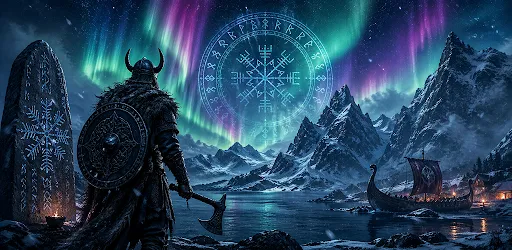

Runic casts and Norse symbols
For runic casts, symbols, and Norse-style oracle work.