The Moon, Dignity and Timing in Horary
The Moon's double role in horary, the void-of-course Moon, Lilly's scoring of essential dignity and the almuten, how the classical rules time an answer, and the considerations before judgement.
 By Arcadia ·
The Solomonic grimoires are often remembered for their spirits, seals and circles, but much of their substance is about time. A work is to be begun on the right day, in the right hour, with the Moon in the right condition. Behind those instructions lies a single ordering of the seven classical planets, the Chaldean order, which also shapes the thirty-six decans of the zodiac, the planetary hours, the names of the days of the week and, by a later synthesis, the minor cards of the tarot and the seventy-two spirits of the Goetia. This article follows that one order through each of them.
The seven planets visible to the naked eye were ranked in antiquity by their apparent speed against the stars, from the slowest to the fastest: Saturn, Jupiter, Mars, the Sun, Venus, Mercury, the Moon. This is the Chaldean order, so called after the Babylonian astronomers to whom later writers credited it, and it is the order in which the planetary spheres were stacked in the Ptolemaic cosmos, Saturn outermost and the Moon closest to the Earth.
Almost every timing scheme in the Western occult tradition is this order, set turning.
The decans began as stars. Egyptian astronomers watched thirty-six groups of stars rise one after another through the year, and used their risings to mark the hours of the night. When Hellenistic astrologers laid the Babylonian zodiac over that older sky, the thirty-six groups became thirty-six arcs of ten degrees each: three to every sign.
Each decan was then given a planet. The scheme that lasted begins with Mars on the first ten degrees of Aries and walks down the Chaldean order: Mars, the Sun, Venus, Mercury, the Moon, Saturn, Jupiter, and round again. Aries therefore has Mars, the Sun and Venus; Taurus has Mercury, the Moon and Saturn; Gemini has Jupiter, Mars and the Sun, and so on to the end of Pisces. Thirty-six is not a multiple of seven, so the cycle does not close evenly. Mars takes the first decan of the zodiac and the last, six decans in all, while every other planet takes five.
These rulers are often called the “faces” of the planets. Ancient and medieval astrologers counted a planet in its own face as having a small share of dignity there, and the images of the decans, described in texts from late antiquity through the Renaissance, gave each ten-degree arc its own picture and character.
The same order turns the planetary hours, which rest on two simple rules. The hours follow the Chaldean order, and the first hour after sunrise belongs to the planet that rules the day. An hour of Saturn is followed by an hour of Jupiter, then Mars, then the Sun, exactly as a Saturn decan is followed by a Jupiter decan. A decan names a planet, and the planet names its hours.
Put the two rules together and the week falls out of them. A day has twenty-four hours and the cycle has seven planets, so after one full day the sequence has moved on three places. If Saturn rules the first hour of one day, the first hour of the next belongs to the Sun, then to the Moon, then to Mars, Mercury, Jupiter and Venus.
That is the order of the week as it is still spoken in many languages: Saturday, Sunday, Monday, and on through the days named in English after Tiw, Woden, Thor and Frigg, who stand in for Mars, Mercury, Jupiter and Venus. The Romance languages keep the planets more openly: in French, mardi, mercredi, jeudi and vendredi are the days of Mars, Mercury, Jupiter and Venus. The Roman historian Cassius Dio, writing in the early third century, already gave this explanation for the order of the days in Book XXXVII of his Roman History.
The European grimoires, including the Key of Solomon, divide the daylight into twelve equal parts and the night into twelve more. These are the “unequal” or seasonal hours. A summer day hour is long and a winter day hour short, and only at the equinoxes are all twenty-four the same length. To find the planetary hours for any date and place, one needs the times of sunrise and sunset, not a clock divided into sixty-minute units.
Two consequences follow. The planetary day begins at sunrise, not at midnight, and the night belongs to the day before it. A question asked at two in the morning on a Tuesday still belongs, by this reckoning, to Monday night, and so to the day of the Moon.
The same seven rulers appear in Indian astrology as the lords of the horā. The word is usually taken to share its root with the Greek hōra, “hour”, and the rules are the same: the horās turn through the day in the Chaldean order, and the first horā after sunrise belongs to the lord of the weekday. The Sanskrit names of the weekdays follow the same planets in the same order, Sunday (Ravivāra) belonging to the Sun, Monday (Somavāra) to the Moon, and so on round the week.
Where the traditions part is in the length of the hour. Some Indian almanacs divide day and night into twelve unequal parts each, as the grimoires do. Others count horās of a fixed sixty minutes from sunrise. The ruler of the first hour is the same either way, but the rulers later in the day can differ, especially far from the equator and far from the equinoxes, where day and night are most unequal. Both traditions agree that the planetary day begins at sunrise.
In the late nineteenth century the Hermetic Order of the Golden Dawn placed two more systems on the wheel of decans.
The first was the tarot. In the Order’s document known as Book T, the numbered cards from two to ten of each suit were laid on the thirty-six decans. The suit follows the element of the sign: the fire signs carry Wands, the water signs Cups, the air signs Swords and the earth signs Pentacles. The number follows the sign’s place in its season: two to four for a cardinal sign, five to seven for a fixed sign, eight to ten for a mutable one. Each card keeps the planet of its decan. The Two of Wands is therefore Mars in Aries, the Three the Sun in Aries, the Four Venus in Aries, and the Five of Wands Saturn in Leo. Much of the meaning given to the minor cards in the Rider-Waite and Thoth decks follows from these attributions.
The second system was the Goetia, the first book of the Lesser Key of Solomon. Each decan was split into two halves of five degrees, called quinaries or quinances, giving seventy-two divisions for the seventy-two spirits. Spirits one to thirty-six took the first half of each decan in turn, and spirits thirty-seven to seventy-two the second half. The pairs are sometimes described as the day and night spirits of the same decan.
Follow a single decan through all three systems. Aries from zero to ten degrees is ruled by Mars. In the tarot it is the Two of Wands. In this Goetic arrangement it holds Bael, the first spirit, in its first five degrees, and Phenex, the thirty-seventh, in its second. An hour of Mars is the hour associated with both.
It is worth being clear about what is old here and what is not. The decans and their Chaldean rulers are ancient. The tarot and Goetic layers are a Victorian synthesis, and the Lesser Key itself places no spirit on a decan. The wheel is a way of reading several traditions side by side, not evidence that they were ever one.
The Key of Solomon is, among other things, a book about timing. It asks that each work be begun in the day and hour of the planet whose nature suits it. It pays attention to the Moon as well: a work should not be begun while the Moon is close to the Sun and hidden in its light, but after it has come out of the Sun’s rays and begun to grow.
Astrology has two arts that approach the same question from opposite sides.
Electional astrology works forward. Given something one intends to do, it looks for a future moment whose chart favours it. The grimoire’s choice of day, hour and lunar phase is a simple kind of election, using only a few of the factors a full election would weigh.
Horary astrology works in the other direction. It does not choose the moment. It takes the moment a question is sincerely asked, casts a chart for it, and reads the answer from that chart. The seventeenth-century astrologer William Lilly set out its methods in English in Christian Astrology, published in 1647, and his book remains the standard text.
Before judging, Lilly asks whether a chart is fit to be judged at all: whether it is radical. One of his tests uses the planetary hour. The chart is taken to be radical when the lord of the hour and the lord of the ascendant agree, either by being the same planet, or by being of the same triplicity, or of the same nature. If they do not agree, the astrologer should proceed with caution, because the chart may not describe the matter truly.
So the same seven rulers, turning through the day in the same Chaldean order, serve both arts. In the grimoire the hour is chosen to match the work. In horary the hour is found already in place, and its agreement with the ascendant is a sign that the question and the moment belong together.
Neither tradition treats the hour as sufficient by itself. The grimoire adds the day and the condition of the Moon; Lilly adds a list of further considerations before any judgement is given. The hour is a first check, not the whole of the answer. What it offers, in both arts, is a way of asking whether the quality of a moment matches the nature of what is being done in it, and that question, more than any single rule, is what the Solomonic attention to time is about.
The Moon's double role in horary, the void-of-course Moon, Lilly's scoring of essential dignity and the almuten, how the classical rules time an answer, and the considerations before judgement.
How a horary question is assigned to a house, how the wheel is turned for other people's affairs, and how applying aspects, translation, collection, prohibition and refranation decide whether a matter comes about.
How Egyptian magic actually worked in objects, names and handbooks, how its script shaped our alphabet, and how its papyri reached the European grimoires while tarot's Egyptian past was invented.
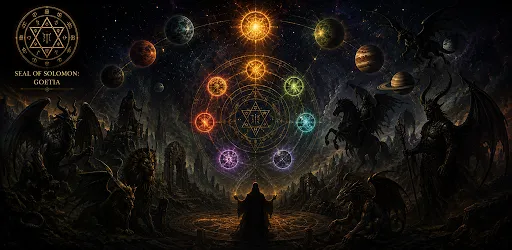

Planetary hours and the 72 spirits
For planetary hours, Chaldean rulers, and the 72 spirits.